
Flat Feet Exercises
Flat Feet Exercises : Our feet carry us through almost everything we do—from walking and climbing stairs to exercising, standing at work and simply moving around the house. Yet foot strength often gets overlooked.
One common concern is flat feet, a condition in which the arches of the feet are low or appear flattened when standing. For Example some people, flat feet cause no symptoms at all. For others, they may be associated with foot fatigue, stiffness, discomfort or reduced stability.
The good news is that you can give your feet more attention with simple strengthening and mobility exercises.
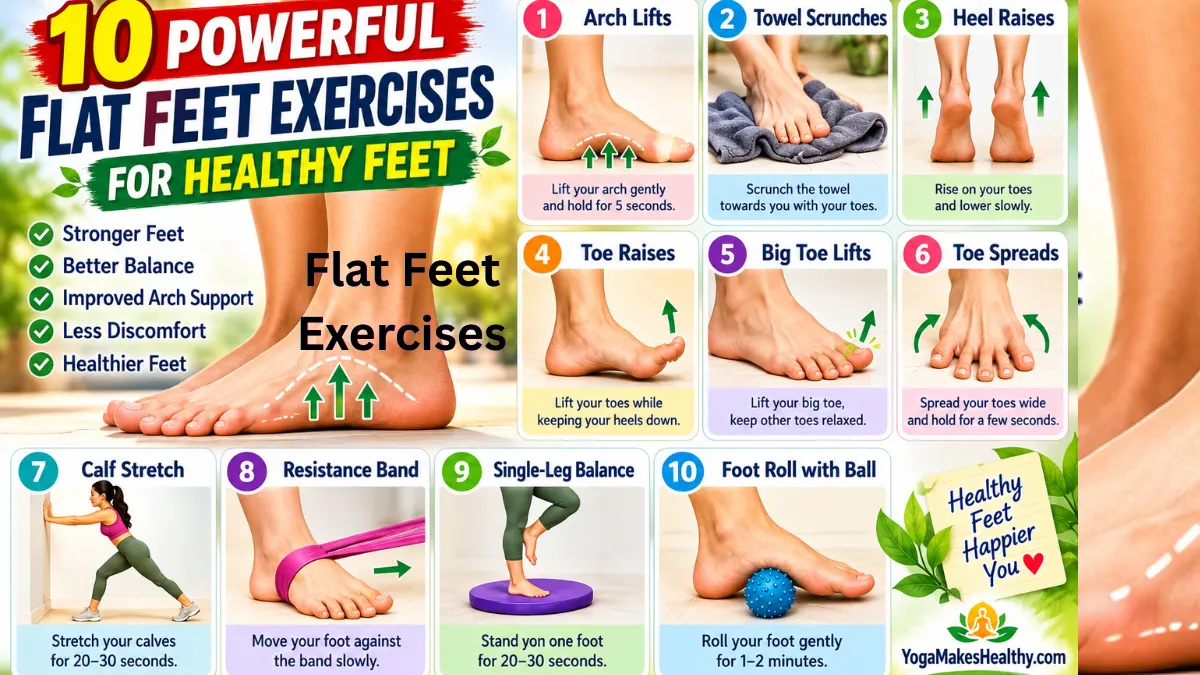
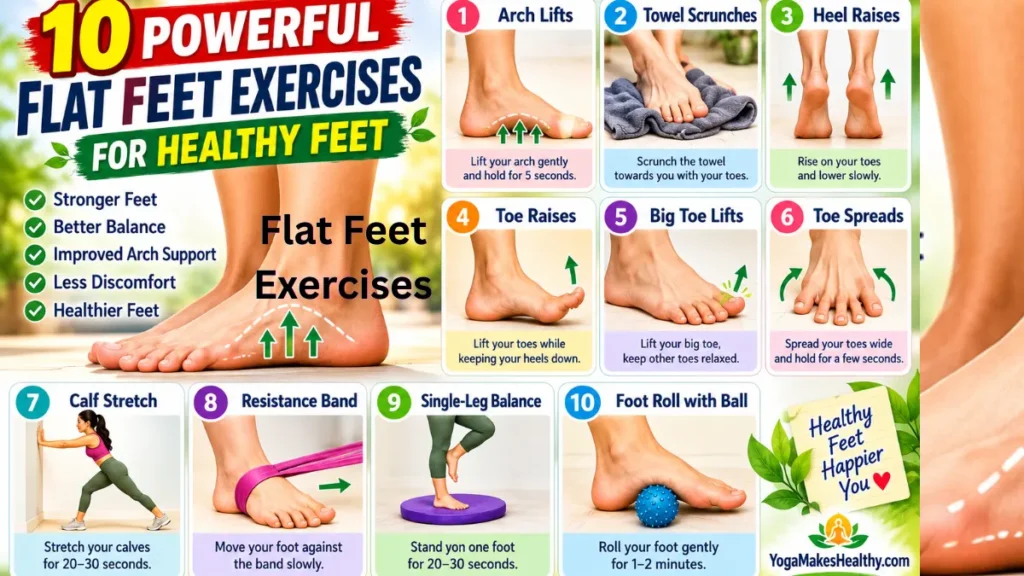
In this article, we explore 10 flat feet exercises that can be performed at home with little or no equipment.
Note: However Exercises may improve foot and ankle strength, movement and control, but they cannot guarantee that the physical shape of a flat foot will permanently change.
What Are Flat Feet?
A healthy foot has a natural arch along its inner side. With flat feet, this arch is lower than usual and may become less visible when you stand.
Some people have flat feet from childhood, while others develop flatter arches over time.
Having flat feet doesn’t automatically mean something is wrong. If there is no pain or functional difficulty, treatment may not be necessary.
However, if your feet become painful, weak or increasingly flat, professional assessment can help identify the cause.
10 Best Flat Feet Exercises
1. Arch Lifts
Arch lifts are one of the simplest ways to practice controlling the muscles underneath and around your foot.
How to do it:
- Stand barefoot with your feet comfortably positioned.
- Keep your heel and toes touching the floor.
- Without curling your toes, gently draw the ball of your foot toward your heel.
- Allow the inner arch to lift slightly.
- Hold for a few seconds.
- Relax.
Try: 10–15 repetitions per foot.
The movement should be subtle. You don’t need to force your foot into a high arch.
2. Towel Scrunches
This exercise works the small muscles involved in toe and foot control.
How to do it:
- Place a towel on the floor.
- Sit comfortably in a chair.
- Put one bare foot on the towel.
- Use your toes to gradually gather the towel toward you.
- Relax and straighten the toes.
- Repeat.
Try: 2 sets of 10–15 repetitions.
This is particularly convenient because you don’t need any special fitness equipment.
3. Heel Raises
Strong calves and controlled ankle movement are important for everyday walking and standing.
How to do it:
- Stand behind a sturdy chair.
- Place your feet approximately hip-width apart.
- Slowly raise both heels.
- Pause at the top.
- Lower your heels slowly.
Try: 2–3 sets of 10–15 repetitions.
As your strength improves, you can discuss progressing to single-leg variations with a qualified professional.
4. Big-Toe Lifts
The big toe contributes to foot stability and movement during walking.
How to do it:
- Sit or stand comfortably.
- Keep your other toes relaxed.
- Lift your big toe while keeping the rest of the foot stable.
- Lower it slowly.
- Repeat.
Try: 10–15 repetitions on each foot.
Don’t force the movement if you experience pain or stiffness.
5. Toe Spreads
Toe spreading encourages awareness and control of the forefoot.
How to do it:
- Sit comfortably.
- Keep your heel on the ground.
- Try to gently spread your toes apart.
- Hold briefly.
- Relax.
Try: 8–12 repetitions.
At first, you may find that some toes don’t move independently. That’s normal. Focus on controlled effort rather than perfect movement.
6. Calf Stretch
Limited calf flexibility can affect how the ankle and foot move.
How to do it:
- Stand facing a wall.
- Place your hands on the wall.
- Step one foot backward.
- Keep the back heel down.
- Bend the front knee.
- Lean forward gently until you feel a stretch in the back leg.
Hold: 20–30 seconds on each side.
Avoid bouncing or forcing the stretch.
7. Short-Foot Exercise
The short-foot exercise is another way to train the muscles that help control the arch.
Steps:
- Sit or stand with your foot flat.
- Keep the toes relaxed.
- Gently draw the ball of the foot toward the heel.
- Allow the arch to rise slightly.
- Hold for about 5 seconds.
- Release.
Try: 10 repetitions per foot.
The objective is controlled muscle activation, not a dramatic change in foot shape.
8. Single-Leg Balance
Balance training can help develop coordination between the foot, ankle and leg.
How to perform it:
- Stand next to a wall or sturdy chair.
- Lift one foot from the floor.
- Balance on the other foot.
- Keep your standing foot steady.
- Hold for 20–30 seconds.
- Change sides.
If balancing is difficult, keep one hand lightly on a wall.
Progression
Once you’re comfortable, you can gradually reduce the amount of support.
Safety comes first—perform this exercise somewhere you won’t fall.
9. Resistance-Band Ankle Exercise
A resistance band can add an extra challenge to ankle strengthening.
Basic method:
- Sit comfortably.
- Secure a resistance band safely.
- Place the band around your foot.
- Move your foot slowly against the band’s resistance.
- Return to the starting position under control.
Try: 10–15 repetitions.
Start with light resistance. If you have an existing ankle injury or significant pain, seek professional guidance before using resistance bands.
10. Gentle Foot Massage With a Ball
A small soft ball can be used for gentle movement under the sole of the foot.
How to do it:
- Sit down.
- Place the ball underneath your foot.
- Slowly roll it from the heel toward the front of the foot.
- Use comfortable pressure.
- Continue for 1–2 minutes.
This can be a relaxing addition to your routine, especially after a long day on your feet.
Important: Don’t aggressively press on painful areas.
A Simple 10-Minute Routine for Flat Feet
You don’t have to perform every exercise in one session.
Try this beginner-friendly sequence:
| Exercise | Duration/Repetitions |
|---|---|
| Arch lifts | 10 reps |
| Towel scrunches | 10 reps |
| Heel raises | 12 reps |
| Big-toe lifts | 10 reps |
| Calf stretch | 20–30 sec |
| Single-leg balance | 20 sec |
| Gentle ball roll | 1 minute |
Perform the exercises slowly and concentrate on your technique.
Can Flat Feet Exercises Build Your Arch?
This is an important distinction.
Strengthening exercises can improve muscle strength, coordination and functional control around the foot and ankle. However, they should not be promoted as a guaranteed method for permanently changing the anatomical shape of your feet.
The goal should be better movement and comfort rather than chasing a particular arch shape.
Think of your feet like the foundation of your body: improving their strength and control can make everyday movement more efficient.
Benefits of Regular Foot Exercises
A consistent foot-strengthening routine may help support:
Better Foot Strength
Exercises can challenge muscles involved in controlling the foot.
Improved Balance
Single-leg exercises train the foot and ankle to stabilize your body.
Greater Mobility
Stretching and controlled movements can help maintain comfortable movement.
Better Movement Awareness
Slow exercises teach you to notice how your toes, arches and ankles move.
Stronger Ankle Control
Heel raises and resistance exercises can complement a broader lower-body strengthening routine.
5 Tips for Exercising With Flat Feet
1. Start Slowly
If you haven’t trained your feet before, begin with a small number of exercises.
2. Prioritize Technique
Ten controlled repetitions are often more useful than 30 rushed repetitions.
3. Don’t Ignore Pain
Exercise should not cause significant or progressively worsening pain.
4. Wear Comfortable Footwear
If your feet become uncomfortable during daily activities, properly fitting and supportive footwear may be worth considering.
5. Be Consistent
Foot strength doesn’t develop overnight. A manageable routine performed consistently is better than occasional intense workouts.
When Should You Get Professional Help?
Flat feet are not always a medical problem. However, professional assessment is appropriate if you experience:
- Persistent or worsening foot pain
- New swelling
- Numbness or weakness
- Difficulty walking
- Frequent ankle problems
- Significant balance problems
- A newly developed flat foot
- One foot becoming noticeably flatter than the other
- Pain that interferes with normal activities
A physiotherapist, podiatrist or doctor can assess your individual foot mechanics and recommend an appropriate programme.
Frequently Asked Questions
1. Are flat feet exercises suitable for everyone?
Not necessarily. The right exercises depend on your symptoms, age, activity level and any existing injuries. If you’re experiencing significant pain, get professional advice before beginning a new exercise programme.
2. How long does it take to strengthen the feet?
It varies from person to person. Strength and movement control generally develop gradually, so consistency is more important than expecting immediate results.
3. Can I do flat feet exercises barefoot?
Many simple foot exercises can be performed barefoot because this allows you to feel the floor and observe your foot movement. However, exercises should always be performed safely and comfortably.
4. Can children have flat feet?
Yes. Flat feet can occur in children, and the appearance of the arch can change as they grow. Persistent pain or functional problems should be discussed with a healthcare professional.
5. Can yoga help support healthy feet?
Yoga includes movements involving balance, mobility and body awareness, which can complement a general foot-strengthening routine. However, yoga should not be considered a guaranteed treatment for structural flat feet.
#FlatFeetExercises, #FlatFeet, #FootExercises, #HealthyFeet, #FootStrengthening, #ArchSupport, #FootPainRelief, #FallenArches, #Physiotherapy, #FootHealth, #FitnessTips, #HealthyLifestyle, #ExerciseForFeet, #StrongerFeet, #Wellness
Conclusion
Your feet may be small compared with the rest of your body, but they play a huge role in movement and stability.
If you have flat feet without symptoms, you may not need to “fix” them. But if your feet feel weak, tired or uncomfortable, incorporating simple flat feet exercises into your fitness routine may help improve strength, control and mobility.
Start with easy movements such as arch lifts, towel scrunches, heel raises and toe exercises. Progress gradually, stay consistent and pay attention to how your body responds.
And remember: stronger feet are built through patience, control and regular practice—not through forcing painful movements.
https://yogamakeshealthy.com/— Move better, feel stronger and make every step count.