

8 Powerful Limbs of Ashtanga Yoga
8 Powerful Limbs of Ashtanga Yoga: In today’s fast-paced world, yoga is often reduced to mere physical exercise. But true yoga is far deeper than that. Based on ancient Indian wisdom, Ashtanga Yoga offers a complete roadmap for living a balanced, meaningful, and mindful life. This timeless system doesn’t ask you to escape from life – it teaches you how to live it fully, consciously, and healthily.
What Is Ashtanga Yoga?
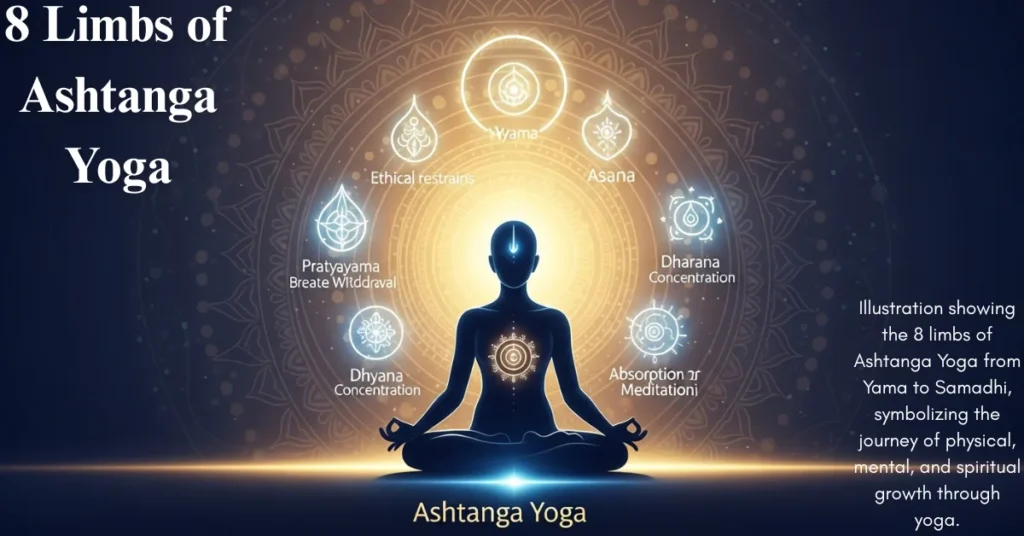
Ashtanga Yoga is a classical yogic philosophy that integrates mind, body, and soul. The word Ashtanga comes from Sanskrit:
- Ashta = eight
- Anga = limbs
Together, they represent eight interconnected practices that lead to self-discipline, mental clarity, inner peace, and ultimately, enlightenment.
8 Powerful Limbs of Ashtanga Yoga
1. Yama – Ethical Discipline
Yama teaches us how to live harmoniously with others. It is the moral foundation of yoga and includes principles like:
- Non-violence (Ahimsa)
- Truthfulness (Satya)
- Non-stealing (Asteya)
- Moderation (Brahmacharya)
- Non-possessiveness (Aparigraha)
Practicing daily Yama creates healthier relationships and a calmer mind.
2. Niyama – Self-Discipline
Niyama focuses on inner habits and personal growth. It encourages:
- Cleanliness of body and mind
- Contentment
- Self-discipline
- Self-study
- Surrender to higher consciousness
Niyama builds emotional resilience and inner strength of a person.
3. Asana – Physical Postures
Asanas prepare the body for meditation by building strength, flexibility, and stability. Beyond fitness, regular practice improves posture, digestion, immunity, and mental focus.
A steady body creates a steady mind.
4. Pranayama – Breath Control
Pranayama is the art of conscious breathing. It regulates life energy (prana), helping to:
- Reduce stress and anxiety
- Improve lung capacity
- Balance emotions
- Increase mental clarity
Breath is the bridge between body and mind—and mastering it brings deep calm.
5. Pratyahara – Withdrawal of the Senses
In a world full of distractions, Pratyahara teaches us to turn inward. By gently withdrawing from external stimuli, the mind becomes quieter and more focused.
This stage marks the transition from outer yoga to inner yoga.
6. Dharana – Concentration
Dharana is focused attention on a single object, thought, or mantra. It sharpens awareness, improves memory, and strengthens willpower.
Where attention goes, energy flows.
7. Dhyana – Meditation
Dhyana is uninterrupted meditation—a state of effortless awareness. The practitioner experiences deep peace, clarity, and emotional balance.
Here, the mind becomes a calm, still lake.
8. Samadhi – Enlightenment
Samadhi is the highest limb of yoga. It is a state of complete union, where the sense of ego dissolves and pure awareness remains.
This is not an escape from life, but a profound understanding of it.
8 Powerful Limbs of Ashtanga Yoga
Why the 8 Limbs of Yoga Matter Today
In modern life filled with stress, anxiety, and imbalance, Ashtanga Yoga offers:
- Mental peace in chaos
- Emotional stability in uncertainty
- Physical health without obsession
- Spiritual depth without dogma
It is a holistic lifestyle, not just a practice.
8 Powerful Limbs of Ashtanga Yoga
How to Apply Ashtanga Yoga in Daily Life
You don’t need to master all 8 limbs at once. Begin gently:
- Practice kindness and honesty
- Add simple yoga postures
- Breathe consciously
- Spend a few minutes in silence daily
Small steps lead to powerful transformation.
8 Powerful Limbs of Ashtanga Yoga
The 8 limbs of Ashtanga Yoga are not ancient rules meant for monks alone—they are living wisdom for modern humans. Whether your goal is health, peace, or self-realization, this yogic path meets you where you are.
Yoga is not about becoming someone else.
It is about coming home to yourself.
AshtangaYoga, 8LimbsofYoga, YogaPhilosophy, MindfulLiving, SpiritualWellness, MeditationPractice, InnerBalance, HolisticHealth, YogaForLife, ConsciousLiving, WellnessJourney, AncientYoga